
Marriage Registration
Home
Marriage Registration
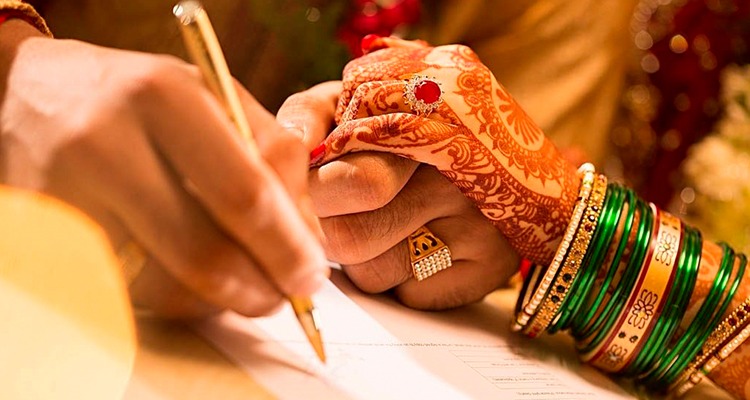
Marriage Registration
As stated in Section 8 of the Act, the state government may make rules for the registration of Hindu marriages that the parties to any of such marriages may have particulars relating to their marriages entered in such a manner and subject to such conditions as may be prescribed in the Hindu Marriage Register. This registration is for the purpose of facilitating the proof of Hindu marriages. All rules made in this section may be laid before the state legislature. The Hindu Marriage Register should be open for inspection at all reasonable times and should be admissible as evidence of the statements contained therein.
Quick Enquiry
How can we help you?
Write to us with your enquiries, questions or Request a meeting with a Lawyer to discuss your potential case. One of our experts would Review the
form and Revert back shortly.
We offer a comprehensive range of marriage services, including Court Marriage Registration, Arya Samaj Marriage, Interfaith Marriage, and assistance with various other marriage procedures, ensuring your union is legally recognized and celebrated.
We provide expert guidance, handle all legal formalities, ensure a smooth and hassle-free process, maintain complete confidentiality, and offer personalized support to make your special day memorable and legally sound.
Yes, marriage registration is mandatory in India as per a Supreme Court directive to protect the rights of both spouses and for various legal purposes like passport applications, visa processing, inheritance, and claiming benefits.
Yes, marriage involving a foreign national can be registered in India, typically under the Special Marriage Act. Specific documents and procedures apply, and we can guide you through the process.
Proof of age (Birth Certificate, Matriculation Certificate, Passport, etc.)
Proof of address (Aadhaar Card, Voter ID, Passport, Utility Bills, etc.)
Passport-sized photographs of both parties
Affidavits declaring marital status, age, and consent.
Witnesses with their identity and address proofs.
(If applicable) Divorce decree or death certificate of a former spouse.
If both individuals have attained the legal marriageable age (18 for the bride, 21 for the groom), parental consent is not legally mandatory. However, for smooth proceedings and family harmony, it’s often advisable to have their support. If parents are not present, an affidavit may be required.
Under the Special Marriage Act (often used for court marriages and interfaith marriages), three witnesses are required. Under the Hindu Marriage Act, typically two witnesses are needed.
The legal minimum age for marriage is 18 years for the bride and 21 years for the groom.