
Court Marriage
Home
Court Marriage
Court Marriage
Court Marriage is a common procedure, which has to be followed by everyone. If a marriage is not registered it is not considered valid during legal procedures such as, applying for a joint home loan. You could also be fined for not registering your marriage. It is a rule that all the marriages have to be registered whether you are having a wedding ceremony or not.
A marriage certificate is an important proof, in case there are some problems between you and your spouse in the future and a legal action needs to be taken.
How to Do Court Marriage in India: Step-By-Step procedure
India is a fusion pot of cultures, each with their traditions and twists when it comes to formalising the marital union between two individuals. But above these marriage customs, there is one common procedure through which a couple can get married legitimately in our country is a court marriage.
As per the Special Marriage Act, 1954, a court marriage is a formal, secular procedure that grants couples the same legal status as those who have married through traditional rituals. In order to perform a court marriage, you have to follow certain important steps. They are:
Organise mandatory documents for a court marriage
Submit the required Documents
Ultimately, a court marriage is a simple civil marriage, is legal union conducted in a court of law, bypassing traditional religious or cultural ceremonies. at a court of law. So, documents which are required for a court marriage are:-
- Proof of Age: birth certificate, other government proof or passport.
- Residential Proof: Aadhaar card, passport, voter ID.
- Passport Size Photographs: Latest photo of both parties.
- Divorce Decree/Death Certificate:Attested copy of divorce decree/order in case of a divorce and death certificate of spouse in case of widow/widower.
- Conversion Certificate: In case one or both of the parties want to convert to another religion before marriage.
- Affidavit: An affidavit declaring the matrimony eligibility, consent and age to the marriage.
Fill up the Marriage Application Form and Submit
So, what about the process of a court marriage?. Once you’ve Collect the documents, the following step is to submit a written application to the Marriage Official in the district where one of you has constantly lived in for at least 30 days. The notice should include necessary information of both parties’ names, jobs and addresses. The application is to be submitted before 30 days of the planned marriage date.
Make the Marriage Notice Produce
Now,. It is the concerned Marriage Officials liability to fix and forward the notice on the office grounds for the people to examine. The notice remains up for normally 30 days, during which time any objections can be made by a third person who does not accept the marriage.
Monitor the No-Objection Period
After the above steps, it’s time to await for 30 days. The marriage can only process in case no challenge are put up in the 30 days. But when someone does raise an objection? In that scenario, the Officer must answer to it and check it out within 30 days of accepting the objection.
Solemnise the relationship
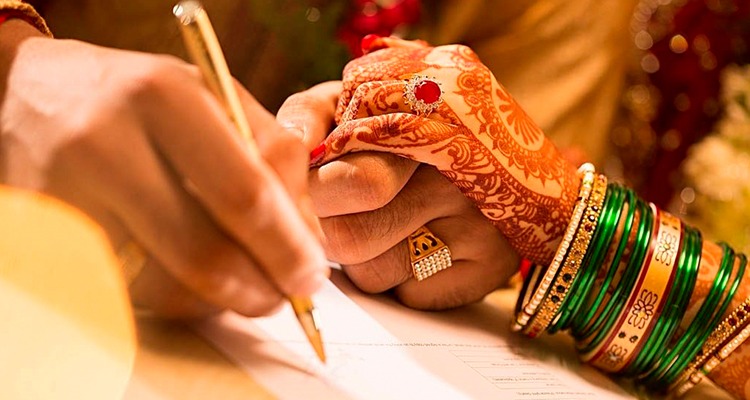
Eventually, we go to the most significant step: the normalisation of the court marriage alone. According to the this Act, both the participants, along with three witnesses, must appear prior to the related Marriage Officer on the given marriage date and submit a declaration. First everyone signs,then the officer countersigns.
Collect the Marriage Certificate
Lastly, the duo who are marrying in the court of law receives their official marriage proof: the marriage certificate. Again, it is signed by all the parties along with witnesses. The Marriage Officer write details as per the certification in their marriage register.
Quick Enquiry
How can we help you?
Write to us with your enquiries, questions or Request a meeting with a Lawyer to discuss your potential case. One of our experts would Review the
form and Revert back shortly.
Notice of Intended Marriage: The couple submits a written notice to the Marriage Officer where at least one party has resided for 30 days.
Publication of Notice: The Marriage Officer publicly displays the notice for 30 days to invite objections.
Objection Period: If any objections are raised within 30 days, the Marriage Officer investigates them.
Solemnization & Registration: If no valid objections are raised (or are dismissed), the marriage is solemnized and registered in the presence of the Marriage Officer and three witnesses.
Issuance of Certificate: A marriage certificate is issued.
If no objections are received during the notice period, a court marriage typically takes 30-45 days from the date of giving notice. If objections are raised, the process may extend.
Yes, a marriage certificate issued under the Special Marriage Act is a legally recognized document globally and is generally accepted for visa applications, immigration processes, and other international legal matters.
No, a Court Marriage under the Special Marriage Act has a mandatory 30-day notice period, so it cannot be completed on the same day. However, for marriages already solemnized under personal laws (like Hindu Marriage Act), registration might be possible on the same day or within a few days.
Yes, parents can serve as witnesses for a court marriage, provided they meet the witness requirements (age, identity proof, etc.).
If an objection is raised during the 30-day notice period, the Marriage Officer will conduct an inquiry into the validity of the objection. If the objection is found to be baseless or not legally sound, the marriage will proceed. We can assist in addressing any legal objections that may arise.